A new study by FAU and Heidelberg University reveals that the human brain anticipates upcoming words while listening, mirroring how AI language models function.
A groundbreaking study conducted by an interdisciplinary team of researchers from Friedrich-Alexander-Universität Erlangen-Nürnberg (FAU) and Heidelberg University has uncovered a fascinating insight into the workings of the human brain. Led by PD Dr. Patrick Krauss and PD Dr. Achim Schilling, this research combines natural listening scenarios with high-resolution measurements of brain activity to explore how our brains process language in real-time.
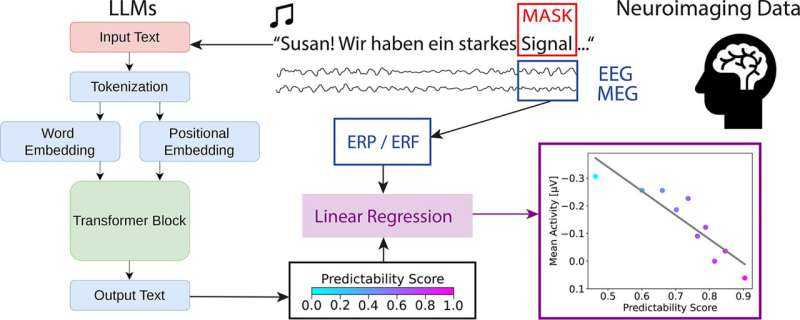
The study involved subjects engaged in normal conversation or speech, allowing researchers to observe their brain activity using advanced neuroimaging techniques. By comparing these findings with the predictions made by an AI language model, the team was able to gain unprecedented insights into the cognitive processes at play during spoken communication.
One of the key discoveries is that while listening, the human brain actively anticipates upcoming words and phrases, much like how modern AI language models function. This predictive ability allows for efficient processing and understanding of speech, even in complex or fast-paced conversations. The researchers found that this anticipation occurs within milliseconds, highlighting the brain's remarkable capacity to process information rapidly.
The combination of natural listening conditions with high-resolution brain activity measurements provided a unique perspective on cognitive neuroscience. By integrating these methods with an AI language model as a reference point, the study offers valuable insights into the parallels between human and artificial intelligence in language processing.
These findings not only deepen our understanding of how the brain works but also have potential applications in fields such as speech recognition technology, neuroprosthetics, and even enhancing human-computer interaction. The research underscores the complex yet elegant mechanisms that govern human cognition and opens up new avenues for future studies in cognitive science and artificial intelligence.
This study represents a significant step forward in our comprehension of language processing within the human brain, aligning with the increasingly sophisticated capabilities of AI models. As technology continues to advance, understanding these parallels could lead to innovations that further bridge the gap between human and machine cognition.