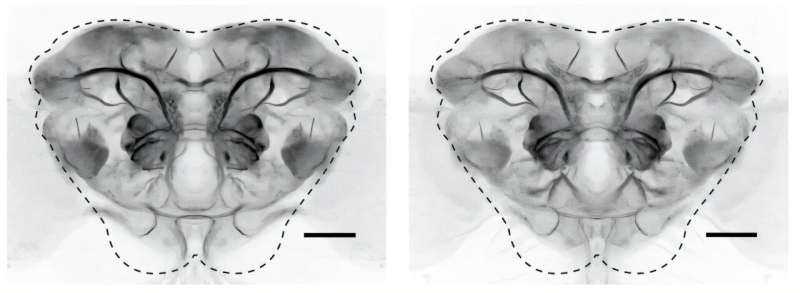
A new study by University of Michigan researchers could streamline future neuroscience studies, potentially accelerating understanding of brain functions in both animals and humans.
A groundbreaking study from the University of Michigan has revealed that the foundational architecture of neurons—termed "ground plans"—could significantly simplify research into brain function and behavior. While E. Josie Clowney acknowledges that neuroscience remains a complex field, this work holds promise for accelerating advancements in understanding neural mechanisms underlying decision-making processes.
The team's focus was on instinctual behaviors observed in fruit flies, which are widely used as model organisms due to their genetic similarity to humans and simpler nervous systems. By analyzing the basic neuronal structures responsible for these innate behaviors, researchers hope to identify universal principles that can be applied across species, including mammals and potentially even humans.
This approach could revolutionize how scientists study complex brain functions by providing a standardized framework. Instead of starting from scratch with each new experiment, researchers might leverage existing knowledge about ground plans to more efficiently explore the intricacies of neural networks and their impact on behavior. This not only saves time but also enhances the accuracy and relevance of findings across various studies.
In essence, this research could serve as a critical stepping stone in bridging the gap between basic neuronal structures and higher-level cognitive processes, ultimately contributing to a deeper understanding of brain function and behavior in both laboratory models and human subjects.