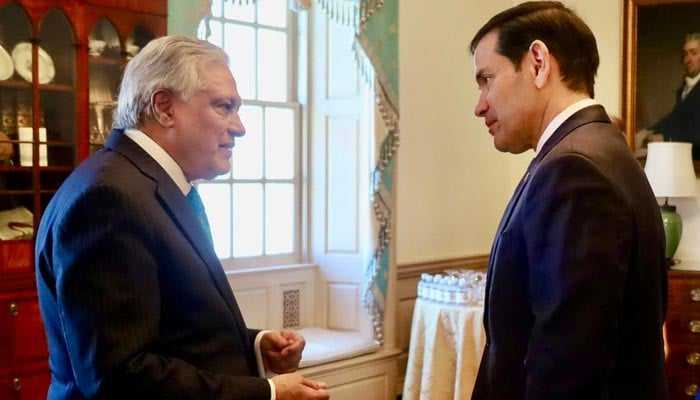
Pakistan's Deputy Prime Minister Ishaq Dar meets US Secretary of State Marco Rubio to discuss Middle East peace process and reiterates Pakistan's position on Israel and Palestine, emphasizing the need for a Palestinian state.
Deputy Prime Minister and Foreign Minister Ishaq Dar recently met with US Secretary of State Marco Rubio in Washington to discuss various issues, including the Middle East peace process. During the meeting, Dar reaffirmed Pakistan's position on the Israel-Palestine conflict, emphasizing the need for a just and lasting solution.
Pakistan has consistently maintained its support for the Palestinian people and their right to self-determination. Dar reiterated that Israel must move towards the establishment of a Palestinian state, in accordance with international law and relevant United Nations resolutions. This stance is in line with Pakistan's long-standing position on the issue, which prioritizes the rights and dignity of the Palestinian people.
The meeting between Dar and Rubio provided an opportunity for the two countries to exchange views on the Middle East peace process and the Abraham Accords. While the Accords have been seen as a significant development in the region, Pakistan has approached the issue with caution, emphasizing the need for a comprehensive and inclusive solution that addresses the concerns of all parties involved.
Rubio hailed Pakistan's commitment to peace and stability in the region, acknowledging the country's important role in promoting dialogue and cooperation. The meeting highlighted the importance of international cooperation in resolving conflicts and promoting peace and security in the Middle East. As the international community continues to work towards a lasting solution to the Israel-Palestine conflict, Pakistan's stance remains a crucial aspect of the regional dynamics.
In the context of the Abraham Accords, Pakistan's position serves as a reminder that a lasting solution to the conflict must be based on justice, equality, and the rights of the Palestinian people. The international community must continue to work towards a comprehensive solution that addresses the concerns of all parties involved, while also promoting peace, stability, and cooperation in the region.